blob: 2c92405ea0ed83af4ce94688c9def59dce5292e1 (
plain)
1
2
3
4
5
6
7
8
9
10
11
12
13
14
15
16
17
18
19
20
21
22
23
24
25
26
27
28
29
30
31
32
33
34
35
36
37
38
39
40
41
42
43
44
45
46
47
48
49
50
51
52
53
54
55
56
57
58
59
60
61
62
63
64
65
66
67
68
69
70
71
72
73
74
75
76
77
78
79
80
81
82
83
84
85
86
87
88
89
90
91
92
93
94
95
96
97
98
99
100
101
102
103
104
105
106
107
108
109
110
111
112
113
114
115
116
117
118
119
120
121
122
123
124
125
126
127
128
129
130
131
132
133
134
135
136
137
138
139
140
141
142
143
144
145
146
147
148
149
150
151
152
153
154
155
156
157
158
159
160
161
162
163
164
165
166
167
168
169
170
171
172
173
174
175
176
177
178
179
180
181
182
183
184
185
186
187
188
189
190
191
192
193
194
195
196
197
198
199
200
201
202
203
204
205
206
207
208
209
210
211
212
213
214
215
216
217
218
219
220
221
222
223
224
225
226
227
228
229
230
231
232
233
234
235
236
237
238
239
240
241
242
243
244
245
246
247
248
249
250
251
252
253
254
255
256
257
258
259
260
261
262
263
264
265
266
267
268
269
270
271
272
273
274
275
276
277
278
279
280
281
282
283
284
285
286
287
288
289
290
291
292
293
294
295
296
297
298
299
300
301
302
303
304
305
306
307
308
309
310
311
312
313
314
315
316
317
318
319
320
321
322
323
324
325
326
|
+++
title = 'Coffee Break Clojure, Transducer'
subtitle = ''
slug = 'clj8'
tags = ["Clojure","Lisp","编程"]
categories = '茶歇蔻芥'
date = 2026-10-18 12:26:01
draft = false
toc = true
endnotes = [
'本文参考了 Rich Hickey 写就的《[Anatomy of a Reducer](https://clojure.org/news/2012/05/15/anatomy-of-reducer)》《[Transducers are coming](https://clojure.org/news/2014/08/06/transducers-are-coming)》《[Reducers](https://clojure.org/news/2012/05/08/reducers)》和 Clojure 参考文档里的 [Transducers](https://clojure.org/reference/transducers) 一节。'
]
fedi = 'https://akk.eltr.ac/objects/bf9d0f91-8af0-4f64-80d3-f10a6b08970c'
+++
在第三期《[只用圆括号怎么够?](/article/clj3/#reduce)》里,我讲到了 `reduce`。
先来简单复习一下:`reduce` 最少接收两个参数,形如 `(reduce f coll)`,其中 `f` 是接收两个参数的函数,形如 `(f x y)`;`reduce` 遍历 `coll` 中的每个元素,先对前两个元素求 `(f a1 a2)`,[^2]然后求 `(f (f a1 a2) a3)`,以此类推。<!--more-->
`(f x y)` 这种函数叫作归约函数(reducing function)。
## 归约、Fold、高阶函数
之前我们用作示例的代码如下:
```clojure
(def numbers '(1 43 231 23 99))
(reduce + numbers)
;; => 397
```
`+` 可以视作归约函数,因为他可以这样调用:`(+ x y)`。当我们对上述代码进行求值时,主要执行了以下步骤:
1. `(+ 1 43)` 得到 `44`
2. `(+ 44 231)` 得到 `275`
3. `(+ 275 23)` 得到 `298`
4. `(+ 298 99)` 得到 `397`
使用 `+` 作为归约函数,对 `numbers` 进行归约(reduce),就实现了累加。
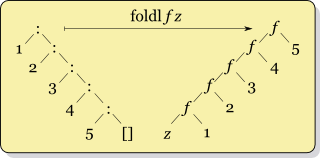
在函数式编程里,归约(reduce)也叫作累积(accumulate)、聚集(aggregate)、压缩(compress)和注入(inject),不过更常见的名字是**折叠**(fold)。折叠分左折叠(`foldl`)和右折叠(`foldr`)。
还记得第三篇讲过的 [Cons](/article/clj3/#圆括号和列表) 和 Lisp 的列表构造方式吗?Fold 的结构就像是函数版本的 Cons。
<div class="md:flex">
<div class="md:w-1/2">
```clojure
(reduce f [1 2 3 4 5])
;; 等价于
(f (f (f (f 1 2) 3) 4) 5)
```
</div>
<div class="md:w-1/2">
```clojure
(list 1 2 3 4 5)
;; 等价于
(cons 1 (cons 2 (cons 3 (cons 4 (cons 5 nil)))))
```
</div>
</div>
Clojure 的 `reduce` 默认是左折叠,即 `foldl`:
要在 Clojure 里实现右折叠,只能把待操作的列表倒序:
```clojure
(reduce f (reverse [1 2 3 4 5]))
;; 等价于
(f (f (f (f 5 4) 3) 2) 1) ; 实际上还是左折叠
;; 如果 f 和 + 一样满足交换律,就等价于
(f 1 (f 2 (f 3 (f 4 5))))) ; 等价于右折叠
```
折叠中的 `f` 本身也可以是折叠。还记得 `into` 吗?
```clojure
(into [1 2 3] [4 5])
;; => [1 2 3 4 5]
;; 等价于
(reduce conj [1 2 3] [4 5]) ;; 这里的 reduce 以 [1 2 3] 为初始值
;; 如果没有初始值,就会用第一个元素做初始值
;; 等价于
(conj (conj (conj [1 2 3]) 4) 5)
```
如果要打平一个向量,比如把 `[[1] [2 3] [4 5]]` 变成 `[1 2 3 4 5]`,就可以用 `into` 作为归约函数(reducing function),也就是把 `(reduce conj ...)` 作为 `reduce` 的 `f`。
```clojure
(reduce into [[1] [2 3] [4 5]])
;; => [1 2 3 4 5]
;; 等价于
(reduce #(reduce conj %1 %2) [[1] [2 3] [4 5]])
;; 等价于
(reduce conj (reduce conj [1] [2 3]) [4 5])
;; 等价于
(conj (conj (conj (conj [1] 2) 3) 4) 5)
```
在 Clojure 中,能够被放在 `reduce` 里使用的函数就叫作归约函数(reducing function)。这个概念与函数式编程和 Lambda 演算的高阶函数(Higher-order function)有关,据说微积分中的导数也算一种高阶函数,但我这篇文章不是讲数学的(我也不会数学),所以就点到为止。
## 改造归约函数
总结一下,归约函数就是这样的一类函数:
```
(f result input) -> new result
```
这样的函数可以相互嵌套使用,不过一般传给 `reduce` 用。
接下来要引入一种新的函数,我没有找到中文译名,暂且称作变约函数(transducer)。它长这样:
```
(t (f result input)) -> (new-f result input)
```
Transducer 接收一个归约函数,返回新的归约函数。
返回函数的函数可能有些抽象,但是在 Clojure 中很常见。我举几个例子解释 Transducer 的用法。
假设我们要对向量自增,然后再累加,就要这样写:
```clojure
;; 下面这个函数先是自增 [1 2 3 4] 得到 [2 3 4 5]
;; 然后再对 [2 3 4 5] 进行累加
(reduce + 0 (map inc [1 2 3 4]))
;; => 14
```
能不能让 `+` 这个归约函数,在把之前的结果和下一个元素累加起来之前,先给要累加的元素 `+ 1`?也就是说,我们不用遍历一遍列表,生成新的、自增后的列表,然后再累加这个列表,而是在累加的过程中就把自增的操作也做了。
我们可以这样写:
```clojure
;; 下面这个函数用 (map inc) 这个 Transducer
;; 把 + 这个归约函数,转换成了新的归约函数
;; 这个新的归约函数的作用是:先给单个元素 +1,然后再累加
(reduce ((map inc) +) 0 [1 2 3 4])
;; => 14
```
这里我们看到了 [Clojure 1.7](https://clojure.org/news/2015/06/30/clojure-17) 引入的 `map` 的新用法。一般而言,`(map f coll)` 的作用是把 `f` 作用在 `coll` 中的每一个元素上,然后生成新的元素。
而 `(map inc)` 则是生成了一个 Transducer,我们把 `+` 作为这个 Transducer 的参数传入,得到了新的归约函数。也就是说,我们将 `(map inc)` 和 `+` 组合,**构造**了新的**数据转换算法**。
对集合中的元素 `inc`,然后再折叠 `+` 实现累加。
这种转换与具体类型无关,与惰性无关,与执行顺序也无关,只是**纯粹的算法**。非常便于复用。
## 将具体类型与转换算法解耦
Clojure 的哲学是简洁,这点并不只是体现在语法(syntax)上,还体现在语义(semantics)和语言的设计上。Rich Hickey 在《[Simple Made Easy](https://www.infoq.com/presentations/Simple-Made-Easy/)》里讲到,简单(simple)的东西就是不和其他东西交织(complect)在一起的东西。
Java 类不简单,因为它既是命名空间,又是数据结构,还定义了数据上的操作——类把三个东西交织在了一起。反观 Clojure,命名空间是单独的概念。
标照 Rich 本人对简单的定义,标准库里的 `map`、`filter`、`reduce` 等操作序列的函数,都不够简单,因为他们不仅涉及做什么操作(what to do),还涉及了怎么做(how to do it)——预设了惰性,预设了数据操作的顺序(序列都是从前往后线性遍历的),预设了数据的表示方式(返回的是序列)。
如果 `map`、`filter`、`mapcat` 等函数,能够与数据类型(序列)**解耦**呢?也就是说,如果 `map` 只定义做什么操作(what to do) ,把怎么做(how to do it)交给其他组件呢?
比方说,`map` 可以这样实现:
```clojure
(defn map [f]
(fn [f1]
(fn [result input]
(f1 result (f input)))))
```
这个 `map` 是构造 Transducer 的函数,它接收函数 `f`,返回了一个返回函数的函数。我们之前看到的 `(map inc)` 就返回了一个 Transducer。
这就是对做什么(what to do)的定义。
`reduce` 则定义了怎么做(how to do it),因为 `reduce` 是对序列的操作,而且是具有惰性的,返回值是惰性序列。所以把 `reduce` 的怎么做(惰性地、顺序地、当作序列执行左折叠)与 `((map inc) +)` 的做什么(“元素自增后再累加”)组合,就得到了完整的数据操作。
如果不想要折叠呢?我能不能直接用 `(map inc)` 累加元素?
将 `sequence`(输入和输出数据为序列、惰性、顺序操作)与 `(map inc)`(“自增集合里所有的元素”)这些要素组合起来,才能得到完整的数据操作:“自增**序列**里所有的元素**逐一**自增,返回**惰性**序列。”
```clojure
(sequence (map inc) [1 2 3])
;; => (2 3 4)
```
如果不想用序列和惰性序列,可以换成向量或者集合:
```clojure
(into [] (map inc) [1 2 3])
;; => [2 3 4]
(into #{} (map inc) [1 2 3])
;; => #{4 3 2}
```
如果没有用 Transducer,我们就必须先把向量变成序列,然后再把序列变回向量。因为 `map` 和许多函数都只操作序列和惰性序列,和具体的数据类型耦合。
```clojure
(map inc [1 2 3])
;; => (2 3 4) ; <- 这里得到的是序列,而非向量
(vec (map inc [1 2 3])) ; <- 必须手动转换成向量!
;; => [2 3 4]
(into [] (map inc) [1 2 3]) ; <- Transducer 不关心数据类型
;; => [2 3 4]
```
上一篇《[异步编程和并发控制](/article/clj7/)》提到的 *channel* 也可以接收 Transducer,携带 Transuder 的 *channel* 会对经过它的所有数据做变换。
```clojure
(def growing-channel (chan 1 (map inc)))
;; => #'user/growing-channel
(put! growing-channel 1)
;; => true
(poll! growing-channel)
;; => 2
```
Transducer 的好处就是,由于他只定义了抽象的「做什么」,而不关系具体的「怎么做」,所以可以非常轻易地用在任何地方,不像 `map` 和 `filter` 只能作用于序列(或者要把向量、集等其他数据类型转换为序列)。
## 组合 Transducer
一般来说,要做 Clojure 里做一系列数据操作,会组合使用很多序列函数。
```clojure
(->> [1 2 3 4 5 6 7 8]
(filter odd?) ; 1. 过滤,只留奇数
(map #(* 2 %)) ; 2. 全部乘 2
(reduce +)) ; 3. 累加
;; => 32
```
有了 Transducer,我们可以把这一系列操作抽象出来,定义成一个独立的、可复用的操作。
```clojure
(def double-odd-numbers
(comp
(filter odd?)
(map #(* 2 %))))
; 可以用来累加
(reduce (double-odd-numbers +) 0 [1 2 3 4 5 6 7 8])
;; => 32
; 等价于
(transduce double-odd-numbers + [1 2 3 4 5 6 7 8])
;; => 32
; 可以不加,返回集合
(into #{} double-odd-numbers [1 2 3 4 5 6 7 8])
;; => #{6 2 14 10}
; 如果你想,还能交给 channel
(def double-odd-chan (chan 1 double-odd-numbers))
```
`comp` 的作用是把函数组合起来。`(comp f g)` 就相当于 `(f (g ...))`。除了用来组合 Transducer,还可以组合普通的函数:
```clojure
(filter #(not (zero? %)) [1 2 0 3 0 2 0])
;; => (1 2 3 2)
; 等价于
(filter (comp not zero?) [1 2 0 3 0 2 0])
;; => (1 2 3 2)
```
不妨做个小练习,定义一个 `pipe` 函数,作用是接收可变数量的函数[^3],将它们构造成类似 `->` 箭头宏的流水线结构,但是不执行这个结构,而是返回函数。比如 `(pipe f1 f2 f3)` 就返回按顺序执行 `f1`、`f2`、`f3` 的函数,`(pipe f1 f2 f3)` 相当于 `(f3 (f2 (f1 data)))`。
<details>
<summary>参考答案</summary>
```clojure
(defn pipe [& functions]
(apply comp (reverse functions)))
```
或者:
```clojure
(defn pipe [& functions]
(fn [value]
(reduce (fn [result f] (f result)) value functions)))
```
</details>
要注意 Transducer 和一般函数的区别。
```clojure
(comp
#(map (fn [x] (* 2 x)) %)
#(filter odd?))
; comp 的结果是 (map fn (filter odd? ...)),很符合直觉
; 返回的函数用来直接操作序列
(comp
(filter odd?)
(map (fn [x] (* 2 x))))
; comp 的结果看似是反过来的 (filter odd? (map fn ...)),其实不然
; comp 并不是 -> 宏,而是函数,会先对参数求值
; filter 和 map 求值之后得到了 Transducer
; comp 是把两个 Transducer 组合起来了,而不是把 filter 和 map 组合起来
; 返回的函数用来和 reduce, into, sequence, chan 等一起使用
```
---
## 最后
这篇的内容可能略显抽象,因为涉及了很多对函数的操作,而不是对数据的操作。如果没理解也没有关系。Transducer 能让数据类型与算法解耦;能轻易地组合复用;给了 Clojure 程序员更多的控制权,所以能借助它来写出性能更好的代码——这些都是好处,但没有这些好处也照样能写 Clojure 代码。
那么,回见!
[^2]: 也可以指定初始值,`(reduce f init coll)` 会先求 `(f init a1)`,再求 `(f (f init a1) a2)`
[^3]: 用 `&` 表示参数数量可变,`(fn [& args])` 中的 `args` 就是包含可变参数的序列。
|